WEBINAR-FIRST GROWTH FOR INFO BUSINESSES

Stop Building New Funnels & Run More Webinars.

WebinarOps operates the complete webinar revenue system, from acquisition and registration through replay, ascension, and retention, so each run produces revenue, intelligence, and a better next decision.

Build My Webinar Forecast Six guided steps. Use exact numbers or mark what you do not know. Forecasts are estimates, not guarantees.
FORECASTING · ACQUISITION · FUNNEL BUILD · ATTRIBUTION · OPTIMIZATION · MONETIZATION
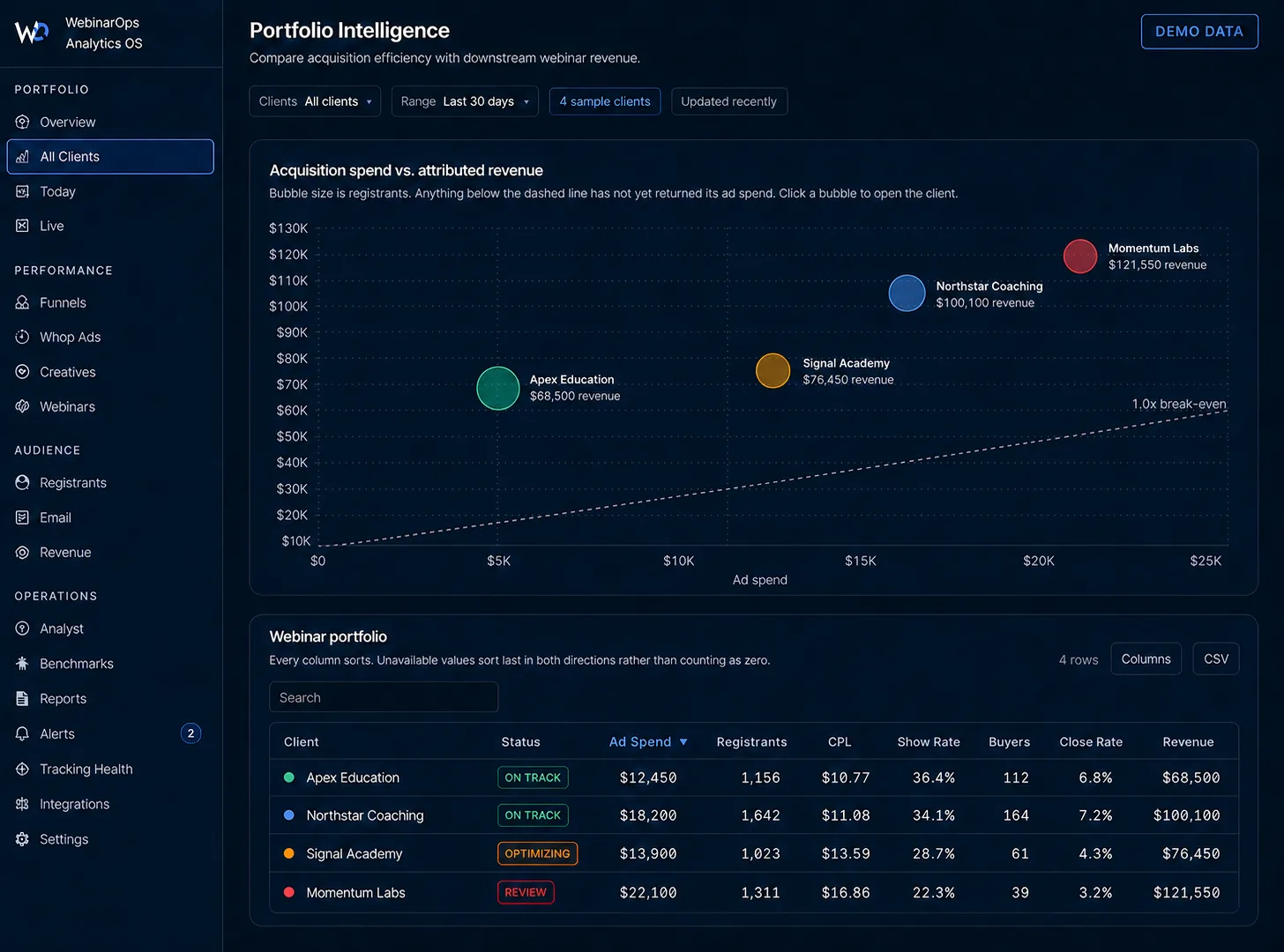
WebinarOps Analytics OS portfolio view, shown with fictional demonstration data
Analytics OS · portfolio viewDemonstration data
DOCTRINE
Webinar First. Expansion Second.
A second mechanism divides the budget and the attention of the first one. We finish the first one.
METHOD
Run. Learn. Improve. Compound.
Cadence, not launches. Each run is read against the forecast and hands its learning to the next one.
OWNERSHIP
One System. One Accountable Team.
Acquisition, funnel, conversion, and attribution answer to the same people and the same numbers.
THE MECHANISM

One mechanism. Multiple revenue events.

Six stages, each with its own economics. Most teams instrument two of them and guess at the rest.

01
Click
Creative, angle, audience, cost per click
Sets the entry price of every registrant behind it.
02
Register
Page conversion, cost per registration, VIP upgrade
Decides how many registrants a fixed budget buys.
03
Attend
Reminder sequence, show rate, watch time
Decides how many of them ever hear the offer.
04
Buy
Live conversion, replay window, checkout recovery
Two conversion windows. Most funnels count one.
05
Ascend
Bumps, upsells, high ticket, continuity
Raises revenue per buyer without raising spend.
06
Return
What the run taught, fed into the next one
Makes the next run cheaper than this one.
Every run returns to the top with better inputs
THE PROBLEM

Mechanism Hopping Resets the Learning Curve.

When a webinar underperforms, most teams add another funnel before learning why. Budget, attention, ownership, and data split across mechanisms, and none of them becomes predictable enough to scale. The argument here is sequencing, not ideology: finish reading the first mechanism before you fund a second. We earn the right to add complexity.

ADDING COMPLEXITY
Four mechanisms, none of them measured to the point of a decision
Attention divided across launches that each run once a quarter
No mechanism accumulates enough data to isolate a single variable
Every new build restarts the learning curve from zero
EXTRACTING FIRST
One mechanism, run often enough to produce real data
Every stage priced, instrumented, and owned by name
One variable isolated per cycle, so the learning compounds
Complexity added only when the data justifies it
We earn the right to add complexity.
THE COMPARISON

Multiple Vendors Own Deliverables. WebinarOps Owns the Economics.

VARIABLE
TRADITIONAL VENDOR STACK
WEBINAROPS
Ownership of the number
TRADITIONAL VENDOR STACKSplit across five contracts. Each vendor reports their own metric.
WEBINAROPSOne team accountable for registration through backend revenue.
Cadence
TRADITIONAL VENDOR STACKA launch per quarter. Four data points a year.
WEBINAROPSRecurring runs against one calendar, one dashboard, one review.
Diagnosis
TRADITIONAL VENDOR STACK"The ad is fine, it must be the page." Nobody can settle it.
WEBINAROPSOne constraint named per cycle, with the math behind the claim.
Monetization depth
TRADITIONAL VENDOR STACKCore offer only. VIP, bumps, and backend are afterthoughts.
WEBINAROPSEvery revenue event priced, positioned, and measured separately.
Speed
TRADITIONAL VENDOR STACKThree calendars and three inboxes per handoff.
WEBINAROPSOne calendar. Decisions and assets are the only constraint.
THE ECONOMIC MAP

The Live Webinar Is Only One Revenue Window.

Five layers sit inside one webinar. A funnel that monetizes only the first is not underperforming, it is unfinished. Opening the others raises what every registrant and every run is worth, not just one conversion rate.

LAYER 01 Front end
Registration page conversion, VIP upgrade, and the cost of every registrant that enters the system.
Common leak: no VIP tier, so a registrant is worth nothing until the core sale.
Registrations · CPR · VIP take rate
LAYER 02 Post-webinar
Replay, deadline, abandoned checkout, and no-sale follow-up. Usually the second-largest revenue window, usually unowned.
Replay conversion · recovery
LAYER 03 Buyer monetization
Order bumps, upsells, and downsells offered to buyers rather than to attendees - a different and far better audience.
Common leak: nothing is offered after the card clears, so intent expires at one transaction.
Bump · upsell · downsell take rates
LAYER 04 Backend
High-ticket ascension and continuity. Whether a buyer is worth one transaction or three is decided here.
Common leak: no defined ascension path, so the best customers are never asked.
Ascension rate · retention
LAYER 05 Intelligence
Attribution, tracking, and the forecast-versus-actual record. This layer is what makes the next run cheaper than this one.
Common leak: gaps counted as zeroes, which quietly rewrite every rate above.
Attribution integrity · variance

Layer five, in practice.

Every campaign is traced forward into registrations, buyers, and attributed revenue, so a budget decision is argued from the downstream number rather than from click cost. Values shown are demonstration data.
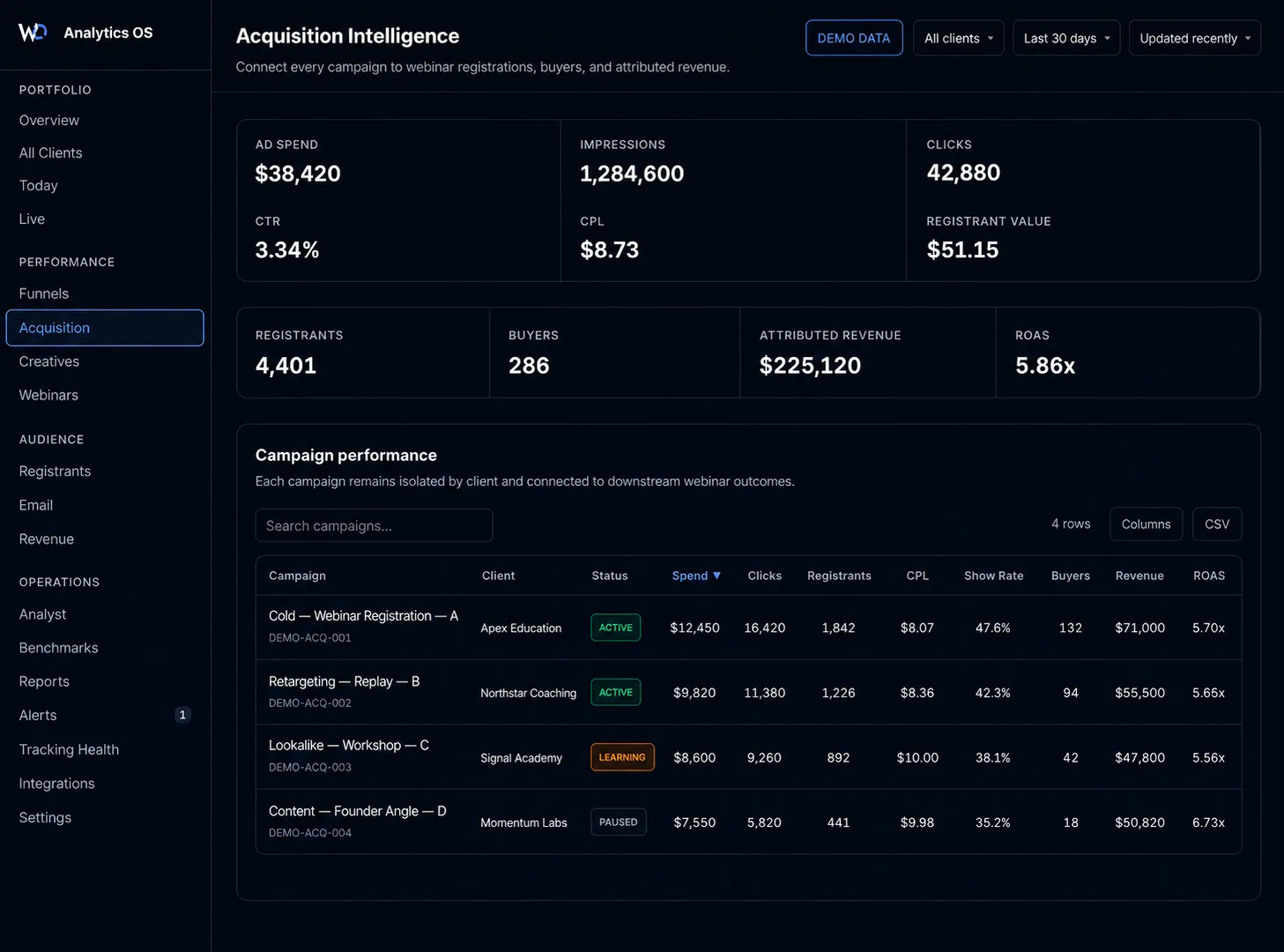
Acquisition intelligence view connecting campaigns to registrations, buyers and revenue, shown with fictional demonstration data
THE LOOP

Every webinar should make the next one smarter.

Four steps, repeated. The value is not in any single run - it is in the fact that nothing is thrown away between runs.

Run
Launch on cadence with one variable deliberately isolated.
What it leaves behind: a clean run with exactly one known change in it.
Learn
Read the run against the forecast and name the variance.
What it leaves behind: a written record of where the model was wrong.
Improve
Change the constraint, not the thing that is easiest to change.
What it leaves behind: a decision with the arithmetic still attached to it.
Compound
Carry the instrumentation forward so nothing is relearned.
What it leaves behind: a baseline the next run starts from instead of guessing at.
WHAT WE OPERATE

Eight stages. One accountable team.

Expansion is the last stage, not the first. Nothing here is sold separately, because none of it works separately.

01
Forecast
Model the economics and the break-even before anything is built.
02
Architect
Offer structure, funnel journey, and cadence designed together.
03
Build
Pages, sequences, checkout, tracking, and the sales handoff as one system.
04
Acquire
Paid acquisition with a testing structure that isolates one variable.
05
Operate
Recurring runs on one calendar, against one set of numbers.
06
Optimize
Weekly review against every stage, one change per cycle.
07
Extract
Open the layers the funnel is not yet monetizing: VIP, replay, bumps, backend.
08
Expand
Add a second mechanism only once the first one is measured and improving.
WEBINAROPS ANALYTICS OS

See What Happened. Know What to Change Next.

WebinarOps connects acquisition, registrations, attendance, buyer behavior, and attributed revenue in one operating view. Every run is measured against the forecast, every variance is visible, and every optimization cycle names one constraint.
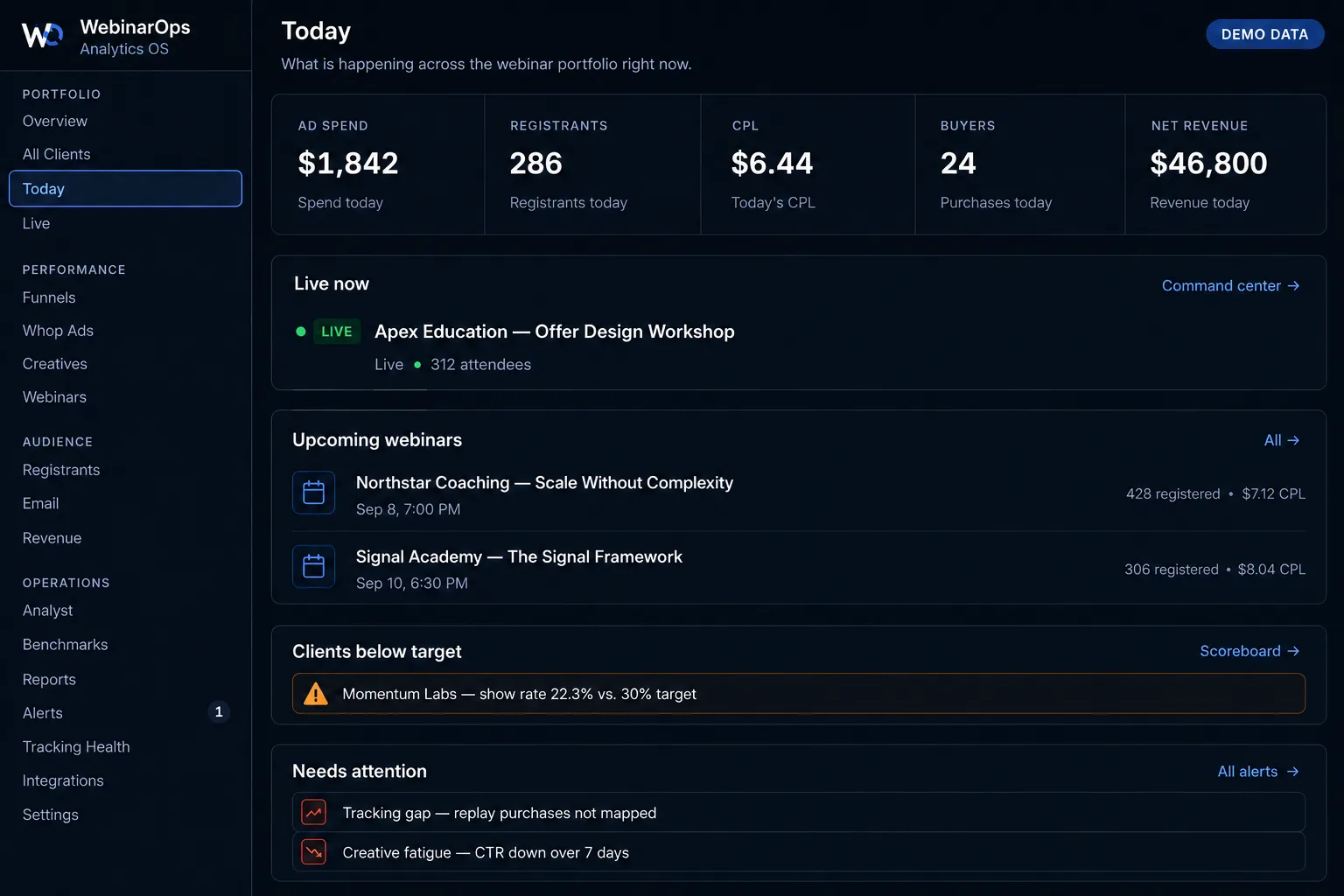
What is live now, and what is next on the calendar
Which clients and runs are below target, named not buried
Tracking gaps flagged as gaps, never quietly counted as zero
WebinarOps Analytics OS daily operating view, shown with fictional demonstration data
Interface shown with fictional demonstration data. No displayed figure represents a client result or expected outcome.
QUALIFICATION

Built for Businesses Ready to Operate the Webinar Repeatedly.

STRONG FIT
+A validated education offer with real customers
+Willing to run the webinar repeatedly, not once
+Able to invest in paid acquisition, paid directly to the platforms
+Fulfillment capacity to serve more customers
+Comfortable making decisions from performance data
+Wants one accountable partner rather than five vendors
NOT READY YET
−No existing offer, or still choosing a business model
−Wants a one-time funnel build or a landing page only
−Unwilling to invest in paid acquisition
−Cannot support additional customers
−Expects a guaranteed result
−Wants the mechanism replaced rather than measured
See What the Numbers Support The forecast is the fastest way to settle whether this is a fit, in either direction.
THE FORECAST

Model the economics before you scale the spend.

Enter the ad budget and conversion assumptions for one webinar. See the modelled registrations, buyers, and gross revenue from that event, including its replay and follow-up sales.

1
Contact and attribution
Who you are, and where this session came from.
2
Business and offer
What you sell, at what price, to whom, with what capacity.
3
Current funnel baseline
Raw counts where you have them, rates where you track them.
4
Unit economics
Cash collected, cost of delivery, and every monetization layer.
5
Scenario and goals
Ad budget, registrations, and conversion assumptions for one webinar.
6
Review and submit
Every value labelled reported, derived, estimated, or unknown.
Build My Webinar Forecast
EXAMPLE OUTPUT ILLUSTRATIVE ONLY
MODELLED GROSS REVENUE PER WEBINAR
$189,995
Target scenario · 1 webinar · $30,000 ad spend
CONSERVATIVE
$123,320
UPSIDE
$256,805
MODELLED ROAS
6.33x
REVENUE / REGISTRANT
$74.72
ILLUSTRATIVE ASSUMPTIONS
One webinar with 38% live attendance, 6% attendee conversion, and 35% additional replay buyers. Includes the calculator’s default VIP, bump, and upsell assumptions.
Forecasts are estimates based on the information and assumptions provided. They are not guarantees of revenue, profitability, advertising performance, or business results.
QUESTIONS

Before you start the forecast

What does WebinarOps actually do?
We build, launch, operate, and improve the acquisition and monetization system around a webinar: offer strategy, funnel architecture, paid acquisition, creative, email and SMS, sales infrastructure, attribution, reporting, and weekly optimization. Those are components of the engine, not products sold separately.
Why webinar first instead of a full funnel ecosystem?
Because a second mechanism divides the attention and the budget of the first one before the first one has been measured. Extracting the value already sitting inside the webinar is faster, cheaper, and produces the data that tells you whether the second mechanism is even the right one.
What does this cost?
There is no fixed package price, because the right investment depends on what your offer economics can support. We price against your model, not a rate card. The forecast is what surfaces that number, and the review call is where we settle it.
Do I need an existing offer?
Yes. This is the requirement with no exceptions. We build the acquisition system around your offer; we do not create the offer or the expertise behind it.
We have tried webinars before and they underperformed. Is that a problem?
It is usually the reason to talk, not a disqualifier. Most underperformance traces to one or two unmeasured stages rather than the mechanism itself. The forecast is how we find out which, before either of us commits more to it.
Is the forecast a guarantee?
No. It is a model built from the numbers and assumptions you enter. Change an assumption and the output changes. Its value is that it makes the assumptions visible and arguable before you spend against them.
What if I do not have complete webinar data?
Mark it unknown. Unknown values stay unknown rather than being quietly treated as zero, and the outputs that depend on them are shown as unavailable. Where you have raw counts but not rates, enter the counts and the model derives the rate and shows the formula.
Does the client cover advertising spend?
Yes. Advertising spend is paid separately and directly by you to the advertising platforms. It never passes through WebinarOps. Some third-party software may also carry its own platform fees.
Can you work with our existing team?
Usually yes. We take ownership of the acquisition and monetization system while your team keeps delivery, subject-matter expertise, and the brand. Where a sales team already exists, we coordinate with it rather than replacing it.
MODEL BEFORE YOU SCALE

Find the Constraint Before You Fund It.

Build a webinar forecast, pressure-test the assumptions behind it, and see which stage deserves the next dollar of attention or spend. You will know what your current numbers support before you commit more of them.

Build My Webinar Forecast
Six guided steps · roughly nine minutes · estimates, not guarantees